
How ancient tales by firelight are finding new life in the digital age.
In the heart of many African communities—before screens and city lights—storytelling was the spark that lit the imagination. At dusk, children would gather in circles while elders took their place by the fire, the stars overhead and the smell of earth rising in the evening air. This was the classroom, the theatre, and the archive of African memory.
Storytelling as living history
African storytelling is not just entertainment. It is a vessel of history, ethics, and cultural identity. Long before writing, oral traditions passed down the wisdom of generations. Each tale carried lessons for life—how to share, how to lead, how to avoid pride, how to forgive.
In Igbo communities of Nigeria, this tradition thrived under the moonlight. Tales of the Tortoise, the Chameleon, the Goat, the Dog, and the Frog taught children how to think critically, live honestly, and understand their place in the world. Known as moonlight stories, they built bonds between elders and youth – between past and present.

When storytelling was education
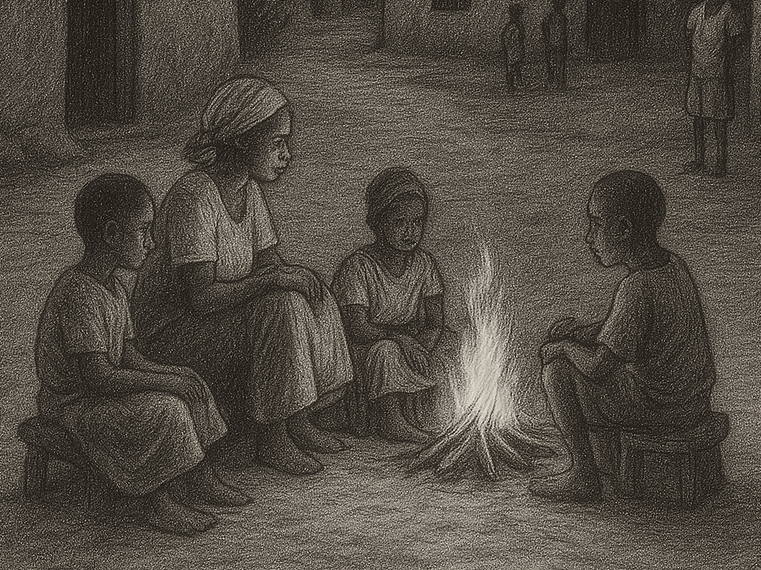
Before formal schools, storytelling was school. Stories were used to teach language, cultural norms, and moral reasoning. Children learned to listen, to question, to interpret metaphor and symbolism.
It wasn’t unusual for a tale to be interrupted by a child’s question—or a challenge from
another listener. And the storyteller responded not just with words but with movement, rhythm, and tone…
Why it began to fade
Today, these stories risk being forgotten. Television, smartphones, and urbanization have replaced firelight with blue light. Many elders no longer hold the position of daily teachers. In some places, imported belief systems have even labeled these stories as “pagan” or “superstitious.”
But the stories themselves? They haven’t disappeared. They are still alive—just waiting to be told.
A new flame: moonlight stories in the Digital Age
That’s where “Moonlight Stories – Fables from Nigeria” comes in. This audiobook project brings classic Igbo storytelling into the 21st century. Aimed at children ages 4–7 (but meaningful for all ages), these stories are narrated in English, Polish, and Danish. They feature rich soundscapes—among others, ogene, ekwe, forest ambience, touches of highlife music—blending traditional storytelling techniques with modern audio design.
Each short tale centers around timeless characters. The trickster Tortoise outwits others—though in reality often outwits himself. The Chameleon blends in, the Dog forgets his place, the Mosquito causes chaos with a single boast. The stories are funny, sharp, and full of heart. And what excellent tools for teaching fairness, humility, courage, and community.
From oral tradition to global platform

By using YouTube and streaming platforms, “Moonlight Stories” transforms the old oral tradition into a digital one—still accessible, still alive. For teachers, parents, and cultural workers, it’s a way to connect children to the values that animated African societies long before modern schooling existed.
The move from firelight to audiobooks is not a break—it’s a continuation. The format has changed, but the purpose remains. To listen. To learn. And to belong.
 IGBO SENTIMENT